Wednesday, March 26, 2008

Traditional who in the what now? (delays due to technological difficulties)

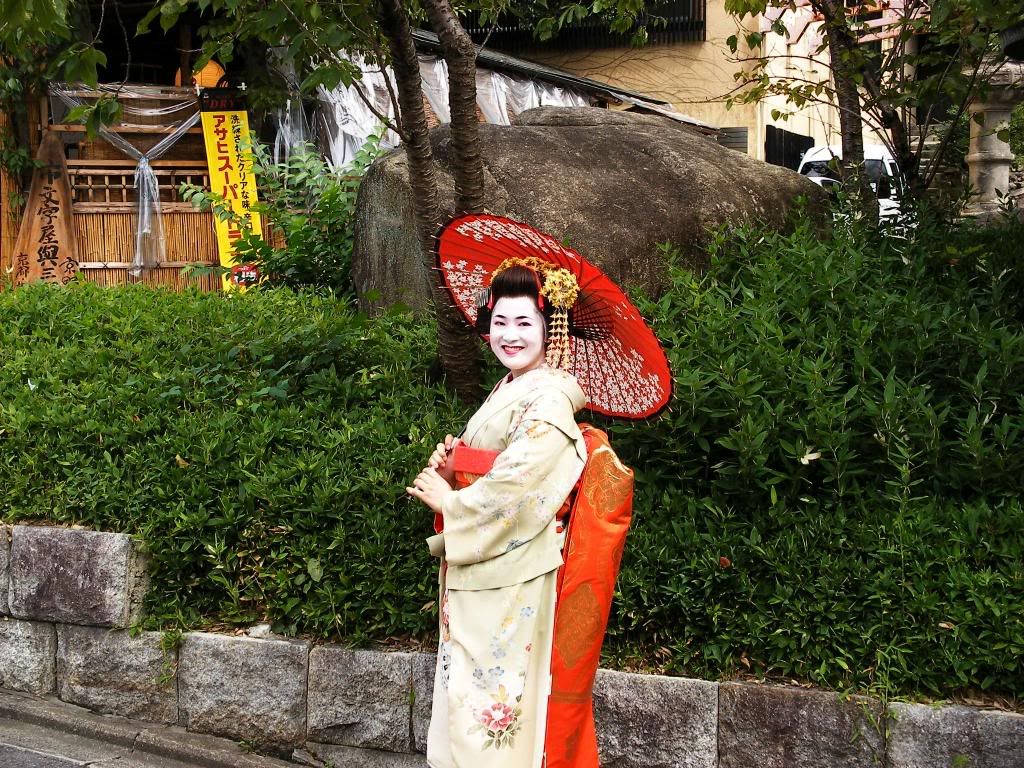
I have read Miyamoto Musashi, I have perused the Wikipedia article on the aesthetic of the world of Wabi-sabi (with the knowledge of the name itself gleaned from a manga about breadmaking)...yet some way, somehow I still felt that my expertise concerning the true essence of traditional Japanese culture. Second hand knowledge was no good; I would have to find out myself.

Donning a hakama and substituting a convenient butter knife for a wakizashi I set out for the countryside in hopes of finding the true spirit of Japan`s traditions. Perhaps I would also hone my skill as an artisan of death with my trusty sidearm.


An hour into my walk and I was yet to find the long, winding roads calling me to my destiny. However, I did stumble upon a teahouse in which I might be able to lighten my wallet in exchange for a calming, comfortable atmosphere.


Perhaps I should have taken the sign promoting it as a teahouse as a warning. It was not the establishment I was expecting. After being ousted rather violently I continued my journey.

Perhaps it was the mild concussion I sustained after being hoisted out by the waistband on my undergarments, but my continued journey produced no sword emporiums, an excess of garish and noisy pachinko parlors, and vending machine after vending machine...I did find solace in a refreshing can of Mitsuya Cider (TM).

I]ll spare my beloved readers the analyzation, but will once again state that much of the traditional culture that many feel is missing was more the tradition of the minority (if not the elite) that that of the overarching notion of Japan. Many seem to take unchanging physical manifestations as a sign of tradtion rather than the customs themselves.

To give a more concrete example, last year I attended a lecture concerning David Rumsey`s Historical Map Collection. One of the maps shown was less a dry, overly-lined geographical map than a colorfully detailed picture noting where travelers could find places in order to make the most of their trip. Who exactly had access to such maps was not revealed, and it it could very well be another example of activities kept from the general populace, but judging from the number of agencies not only dealing in international but domestic travel show that the business of providing informed access to areas unknown to Japanese folk is quite alive and well.


As with the "teahouse" above and the example of travel, tradition doesn:t seem to be so much a matter of keeping secrets closely guarded within specific communities, but what becomes reproduced (or poorly mimicked...damn the teahouse once it has the potential to do so.

Tuesday, March 11, 2008

Globalization and why Japan is ruining my college dietary habits

The trend continues: a continued influx of odd foreign culture into the once pure nation of Japan. Baggy pants, loud music, garish makeup, with those who choose to wear such dastardly facepaint having the audacity to apply it in public places. Even the apparent innocence of a magic show is naught but the Grim Reaper knocking on the door of good culture. Goodbye, o halcyon days.


Or so some say.

While criticisms of Japan's modern, "less-Japanese-y" age are not always leveled at the menacing spectre of foreign influence, such alarmist views are by no means hard to find.

The idea of sullied or somehow unpure "modern" Japanese culture becomes a bit more ludicrous, if not laughable, when one takes a step back in order to realize that the trend has been continuing since the Meiji restoration, where land reformations begat tales of "Poison women" using new systems to exploit others and the rebellious youth were flowing from their cozy agricultural lives to thriving urban centers, forsaking the old ways. Finishing schools for the modern woman and new housing structures putting emphasis on filial harmony with little regard for tradition threatened to destroy what is and always has been(TM). All that and it's not even 1930.

While I don't want to delve too deeply into why Japan has never been "Japan" due to general unawareness on the part of both preceding and succeeding generations, it is something to consider. However, the hodgepodge of historical confusedness pales in comparison to the fact that


I can barely eat pizza here. Mayonnaise, corn, teriyaki sauce, all manner of weird toppings is tantamount to blasphemy. While my opinion has little consequence in the matter I have a hard time believing that most anything I find here pizza-wise would be considered anything other than Japanese overseas. Yes, that includes California. I also understand the slightly ludicrous criticism that a food that originated in Italy, made from a fruit native to South America, of which the style I consume was localized in the States, does not translate in the exact same way in Japan.

The idea is that while the views of nay-sayers on the topic of Globalization are not entirely invalid, the tendency for an "influencing" culture to be countered, warped, and localized to the point it becomes unique if not entirely recognizable from its point of origin is an especially strong one. There are quite a few objects, food (PIZZA!), clothing (of course, kimonos haven't been en vogue as everyday attire for quite a while), landmarks (America Town, save for the tiny statue of liberty and being a monument to endless consumerism, has very little "American-ness" about it) most likely would not be easily reabsorbed into the countries which supposedly spawned them.


An issue to ponder is what exactly makes something adoptable? Why does one mode of expression from a "foreign" culture spark a movement in a separate social space where the social dynamic can range from just slightly dissimilar to drastically different. So-called "World Culture" as represented in the myriad of fashions, music, art, and any number of other things is a very real phenomenon. However, the culture in which those foreign seeds are planted tend to give rise to very different interpretations of the same idea.

Tuesday, February 26, 2008

外人


"Not me. Just the birds and the baby."

This was the reaction upon my whipping out my camera in the park near Hirakata-shi station a couple of weeks ago, followed by a slight twinge of annoyance on my part. This was not only due to my denied opportunity for a nice slice-of-life photograph but also for the man's wherewithal to dictate what I could take a picture of. Of course, as it often does, this particular interaction became a subject to ponder.

The image is presented of Japan through most people's eyes is one of a very group-oriented society where people's awareness of those groups which are inside and outside of their concept of "I" or "we" is incredibly strong. The strength of this awareness is not something I consider to be uniquely Japanese, but that is a moot point at the moment. Why it is relevant is due to the nature of anthropological, or any subject which deals with not only humans but anything within both organic and unnatural environments.

Whether intentional or not the role of the anthropologist is one of an intruder. Regardless of a formal designation as outsider or "native"/insider, the job becomes to step back and observe and catalogue the motions that compose human society. While the ideal is to traverse unnoticed, without disturbing or heavily influencing the setting being observed, in reality it is a goal far from realization.

It becomes even harder when the observer in question stands head and shoulders above a heavy percentage of the population. While holding a rather large camera. Subtlety is not on my side.


Even if that were not the case a more voyeuristic approach is, given by the above example, quite out of the question (well, not quite...). Questions of being rejected by potential subjects aside, it becomes an issue of treading on the private ground of another person even in seemingly public spaces. In the quest for the ever-elusive candid representation of Japan, permission not given is not necessarily denied, but a sly snapshot has the potential to heavily backfire in the form of wrath from the secret snapshot-ee. Oh, the horrors of the communication age.

Being that I am not a ghost slipping through crowded paths with an unnoticeable camera, I find being able to take photos of actual people without obligatory (thought not particularly unnatural and almost certainly anthropologically worthy) peace signs or otherwise not-what-is-normally-done-outside-of-a-photo difficult at best, frustrating at worst.


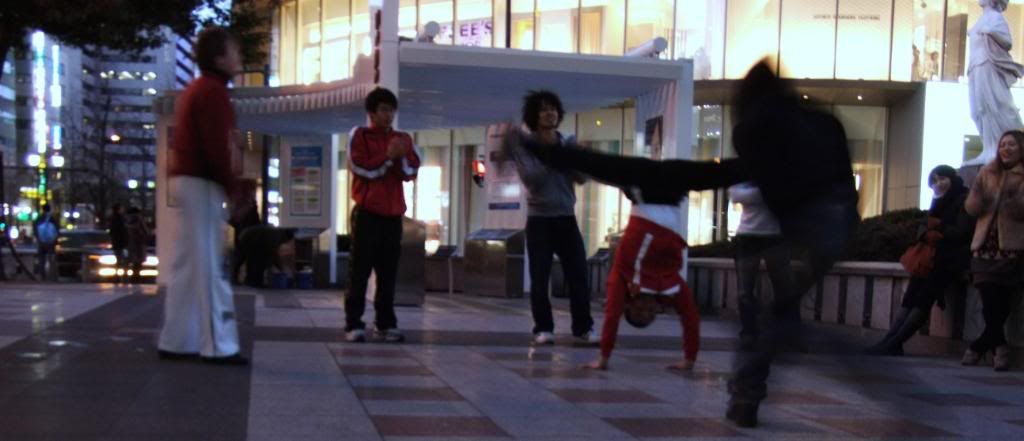
I was able to take this picture during a random wandering through Nanba with a friend, my curiosity piqued by the unmistakable sound of a Capoiera circle. This is a case of permission given with a hearty and perhaps slightly incredulous "Of course you can!" This is a rare case of my having been given permission to capture and capturing something I believed to be organic, despite the subpar quality of my equipment.

From here I believe my trial to one of opportunity countered by at least small attempts at propriety. As mentioned above, the title of outsider, of "gaijin" can be applied to anyone stepping outside the bounds of their normal life in order to observe. The goal is to work within the rules and constraints of my position and sift through the results to find something truly worthy of being included among those images being truly representative of this country.

Tuesday, February 19, 2008

Fujisaka and Katahoko: A verbal version of one of those circle things that you do at school

Eloquent, I know.

Fujisaka Sanchoume is, by any standard definition, unremarkable. In contrast to the area surrounding Kansai Gaidai's Seminar Houses, relatively quiet and lacking in the glare of neon signs and (slightly alarmingly) the normal overabundance of vending machines. When matched against Katahoko Higashimachi Fujisaka is a calm sea of middle-class residential tranquility.


Within a five-to-ten minute walk of the Seminar Houses there are two supermarkets, two clothing shops, several eating establishments of the mom-and-pop persuasion, and a heavy number of vending machines (including the infamous "Beer Vending Machine"). Endure the horrendous pain of walking for five more minutes and the number of supermarkets increases by two, karaoke of the large-scale and hole-in-the wall variety appears, access to eateries moves up the scale to family style restaurant, kaitenzushi, and the ability to buy high-calorie, low-nutritional value snack foods from the ever-willing conbini goes from 0 to 2. Add to that the sweet temptation of three or four pachinko/slot parlors. There are also fashion boutiques (this is possibly qualified by the size of the shop and the abstractness of its' name). Classy.


The domain of Fujisaka is considerably different. While there are obviously houses and families residing within Katahoko, the environment of the former is considerably more...family friendly. This does not mean that the neighborhood lacks pachinko, conbini, and supermarkets (though it does seem to be completely lacking in seedy dives), but that they are fewer and far between: better hidden and thus increasing the potency of the neighborhood-ish appearance. The supermarkets (side by side) are a fair ten or fifteen minute walk away. None of these places face roads that are not fairly traffic-heavy in terms of cars, people, or trains. The remaining conbinis, bakeries, youth centers, and other commercial establishments hover around other types of buildings.

This may be more a conclusion based on correlation than cause, but the lifestyle of the apartment-dweller seems to demand more the type of structures that surround and permeate the neighborhoods around Katahoko more than that of Fujisaka. Those who inhabit Fujisaka seem to demand those more "family-friendly" structures. The seifuku, gakuran, blazer, and yellow-hat attired children tell of numerous schools, the people jogging in the park or watching their children play give hint to people whose lifestyle has moved beyond the necessity of quick convenience or late-night snack runs in order to keep going through study sessions (euphemisms included). The space that encourages a larger amount of self-indulgence is not totally erased, it is only displaced, if only for the sake of appearance.


Fujisaka is by no means the sterile shadow of life that is modern suburbia, but it's certainly more subdued and not a place for the go-go behavior of those perpetual excitement-seekers. It feels like home.

Tuesday, February 12, 2008

From the depths of jaded experience...

I would like to take the opportunity to welcome you to the photo blog for my Visual Anthropology of Japan course at Kansai Gaidai University in Hirakata-shi, Osaka.


Welcome.

Despite the title of our first assigned blog entry being "first impressions of Japan" I, being one of the remnant of last semester (with an ever-persistent penchant for youthful rebellion), will be writing from a viewpoint four or so months after my arrival.

One question that I've found myself asked a considerable number of times since coming here, though far behind "How tall are you?" in terms of popularity, is how many guns I own (the answer being none). The more relevant question, however, has been something to the effect of what about being in Japan has surprised me most about the country. The food, perhaps? The small size of everything ("You probably hit your head all the time, right?")? Since starting homestay the barrage of questions regarding my adjustment has only increased.

Not being one to skimp on vaguely controversial allusion, I remember a passage from Salman Rushdie's The Satanic Verses which went something along the lines of, to paraphrase, a businessman traveling in a plane from Bombay(?) to London experiences a less perilous and strange journey than a farmer traversing the road from his village to the city.

At a rather large risk of sounding blasé, I've found my experience to be largely the same. This is not to say I've not experienced new things: going to castles, wandering about the less-reputable parts of Osaka, walking an obscene amount around the lovely industrial city that is Hirakata-shi and surrounding areas. I've had experiences a-plenty, but what has struck me most is the nostalgic familiarity of it all.


It might be seeing the leaves change and snow fall for the first time in eight or so years, but the experiences I've had here do more to call back my (relative) youth in Chicago than my time in Florida ever has. This is not to say there are no differences, as any movement to a new area requires readjustment, but the readjustment from one modernized area to another seems to be considerably less. The comforts that form the foundation of my first-world lifestyle, though they may appear in slightly-less-familiar forms (such as the seemingly-omnipresent electrical towers looming in the distance), are never lacking.

The spectre of culture shock may still loom in the distance for me, but my experience thus far has been one of a place where it's much more likely to find the traditional. New things a-plenty, but this has struck me as a country where, despite images of samurai and geisha, giant robots and pantyhose vending machines being unleashed willy-nilly on the internets (among other forms of media), one will be hard-pressed to find incredibly exotic as opposed to the traditional in contrast to the almost overwhelmingly modern. This may be, given that my period spent here is still considerably short in comparison, a blind assumption. Stay tuned to see exactly when I'll have my ears boxed for an especially serious faux-pas.